Sometimes, changing a woman’s life begins with giving her the tools to make something of her own.
When Hadija speaks about her work today, she smiles.
“I never imagined that making reusable pads would become the work that feeds my family. Today, I can provide for my child, and every pad I sew reminds me that my life can be different.”
Hadija is a young mother, a Senior Two school dropout and the sole provider for her family. She is also raising a child with special needs. When we first met her, she was selling roasted maize by the roadside near our office, earning approximately UGX 30,000 (about €6.60) in a good month. It was barely enough to meet her family’s basic needs.
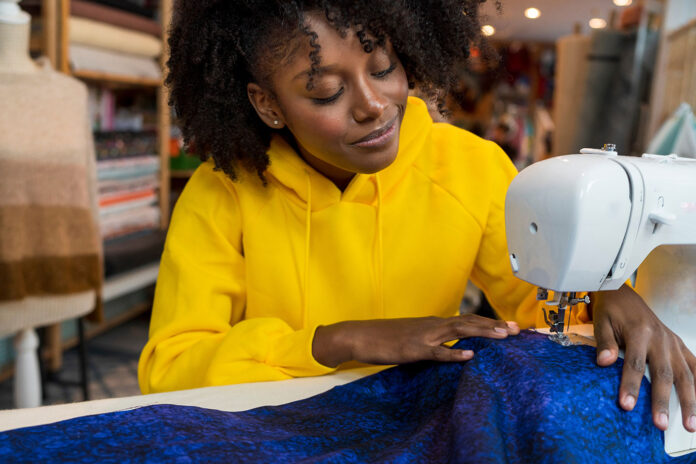
Her story began to change when The Thinking Watermill Society supported Dwona Initiative with two industrial sewing machines. This investment gave us an opportunity to expand the production of our reusable Dwona Fempacks while creating opportunities for women in our community to learn a practical, income-generating skill.
Hadija joined our reusable pad-making training and quickly distinguished herself through her commitment and willingness to learn. Today, she is one of two women employed full-time as tailors at Dwona. Depending on production, she now earns eight to ten times what she previously made selling roasted maize.
For Hadija, this means more than a better income. It means being able to provide for her child, contribute to her family’s wellbeing and approach tomorrow with greater confidence.
And the impact extends beyond her household. With the machines, we have produced more than 5,600 reusable menstrual pads, helping girls access reliable menstrual products and stay in school with dignity.
Since then, The Thinking Watermill Society has extended its support, bringing the total number of machines donated to Dwona to three. What began as an investment in our production capacity has become an investment in women’s livelihoods, girls’ education and community-led solutions to menstrual injustice.
But we are thinking about what comes next.
At Dwona, we believe that addressing menstrual injustice must also involve creating economic opportunities for the women and young people who are often excluded from them. This is why we are developing Denim Flow Lab, an emerging creative social enterprise transforming everyday and upcycled denim into hand-painted products that tell stories about women, girls and menstrual justice.
We have started small, testing products and learning what customers genuinely want. Our hand-painted shoes have received the strongest early response, retailing at approximately €22 for sizes 37–42 and €30 for sizes 43–45.
Our ambition is to grow Denim Flow Lab into a women-centred creative production space where young women can acquire tailoring, artistic and entrepreneurial skills, earn an income through production and gradually take on greater responsibility within the enterprise.
We want to create a place where talent meets opportunity, where creativity becomes an economic asset, and where young women can build livelihoods through products people genuinely love.
Hadija’s story reminds us why this matters. In the right hands, with the right support and opportunity, a sewing machine can become a source of income, independence and possibility.
We are deeply grateful to The Thinking Watermill Society for seeing this possibility and investing in Dwona’s work. Three machines have helped us move from an idea to real livelihoods for two women and thousands of menstrual pads for girls.
We hope that the next chapter will see many more young women walk through our doors, learn a skill, earn an income and discover what they are capable of building.
Because sometimes, the most meaningful thing we can give a young woman is the tools, skills and opportunity to create her own future.